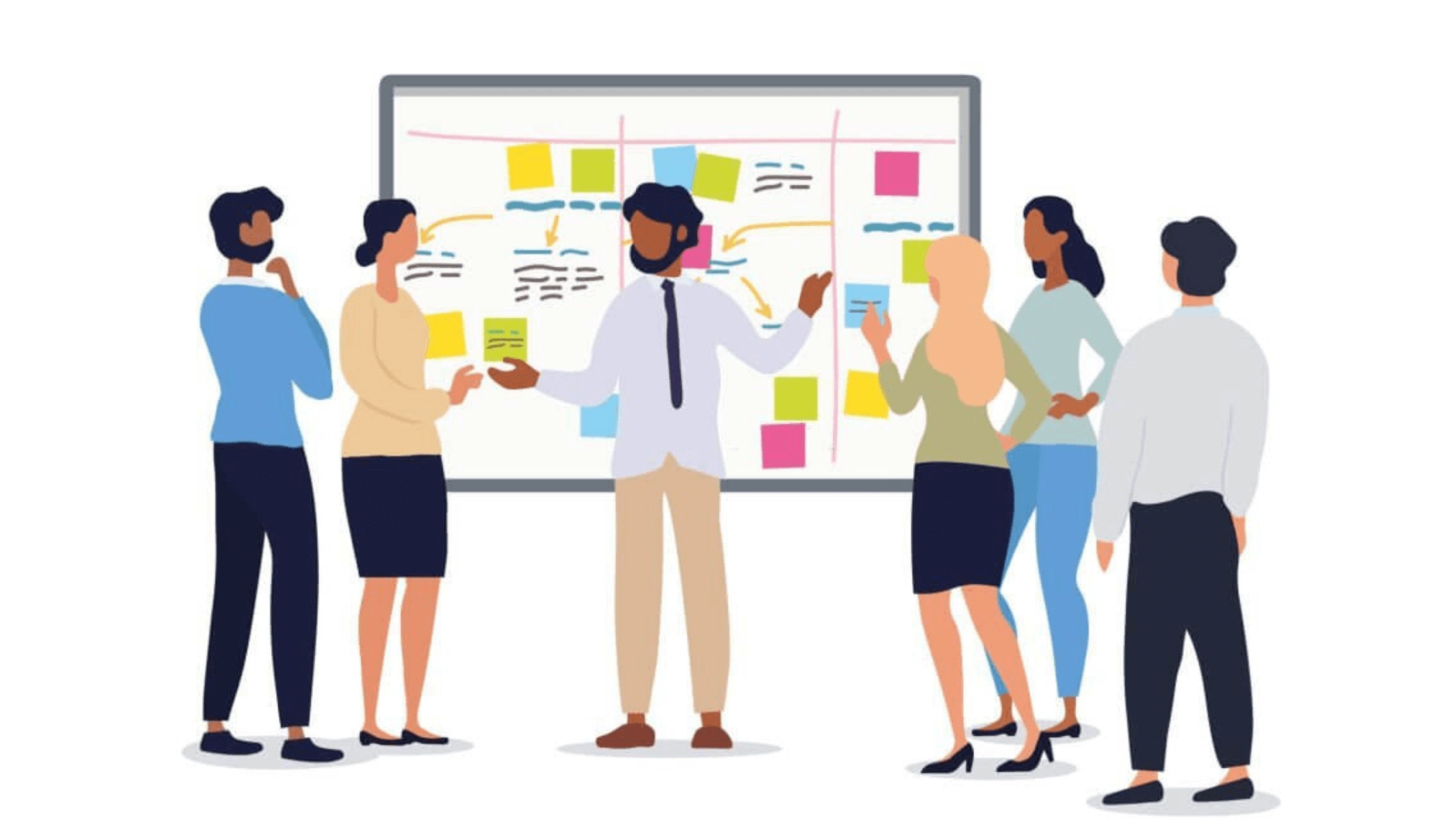

Conversational AI for eLearning gives you a tutor you can speak or type to as you study. If a lesson leaves you with a question, you can ask for a clearer example or check your understanding before you move on. Research suggests that guided practice and trusted course material make this support more useful for self-paced learning.
How conversational AI helps with self-paced learning
In a 2025 Harvard physics trial, 194 students took two lessons. Each student tried a self-paced AI tutor for one lesson and an interactive class for the other. Students made larger gains on short quizzes with the AI tutor and typically spent less time on the lesson. The researchers measured learning right after each lesson. (Kestin et al., Scientific Reports, 2025)
The tutor broke problems into steps and offered feedback as students worked. In practice, that kind of help lets you slow down when a concept is new and move on once you grasp it.
What voice adds to conversational AI for eLearning
In a 2026 working paper, Boston University researchers tested an AI tutor with 86 students in an online MBA finance course. They reported stronger gains for students with access to a tutor that used course materials and guided them through problems. The clearest gains came in how students explained their reasoning.
The same tutor also switched between voice and text each week. Students asked more questions by voice, and their weekly learning scores were similar in both modes. That’s an early result from one course. It suggests that the option to speak can make it easier to ask for help as you study. (Yang et al., 2026 working paper)
How guided practice helps you study on your own
A 2025 study with nearly 1,000 high school math students found that a general chatbot boosted scores during practice. Later, students who used it scored 17% lower on a test they took on their own than students who practised without AI. A tutor that offered teacher-designed hints largely avoided that drop. (Bastani et al., PNAS, 2025)
The same principle works with a conversational AI tutor. Try a question yourself first. If you get stuck, ask for a hint. Then explain your answer in your own words and try a new question on your own. That last step shows you what you can do without help.
Why trustworthy course material matters
A course-grounded AI tutor for online learning draws on specific lessons, guides, or worked examples. One way to do this is retrieval-augmented generation (RAG). The AI looks up relevant passages in the course material before it answers. For exam prep, that helps keep an explanation tied to the version of the exam you’re studying for.
In a 2025 pilot across four university courses, lecturers supplied the materials their AI tutors could use. Experts found that 1.5% of the answers they sampled were incorrect and 16.5% went beyond the supplied material. So it’s worth checking what an AI tutor draws from and whether those materials cover what you need to learn. (Németh et al., Social Sciences & Humanities Open, 2025)
In separate question-answering tests, researchers improved accuracy by prioritizing reliable sources when the available sources varied in quality. When you choose an AI tutor for a certification course, look for current, reviewed course material that you can refer back to. (Hwang et al., EMNLP, 2025)
How Brain Sensei uses conversational AI for eLearning
Brain Sensei’s AI-Powered PMP® Exam Prep Course & Exam Simulator applies these ideas to self-paced certification training. Your AI Sensei teaches the 35-hour course in a natural voice. You can interrupt to ask a question, get another explanation, and then pick up where you left off. The tutor uses your current lesson to guide its replies. It draws on Brain Sensei’s course material, updated for the PMP exam that launched in July 2026.
For example, in the Common Vision lesson, you might ask, “How can a project team agree on a shared goal if two stakeholders want different things?” After the explanation, you can try a quiz to see whether you can apply the concept.
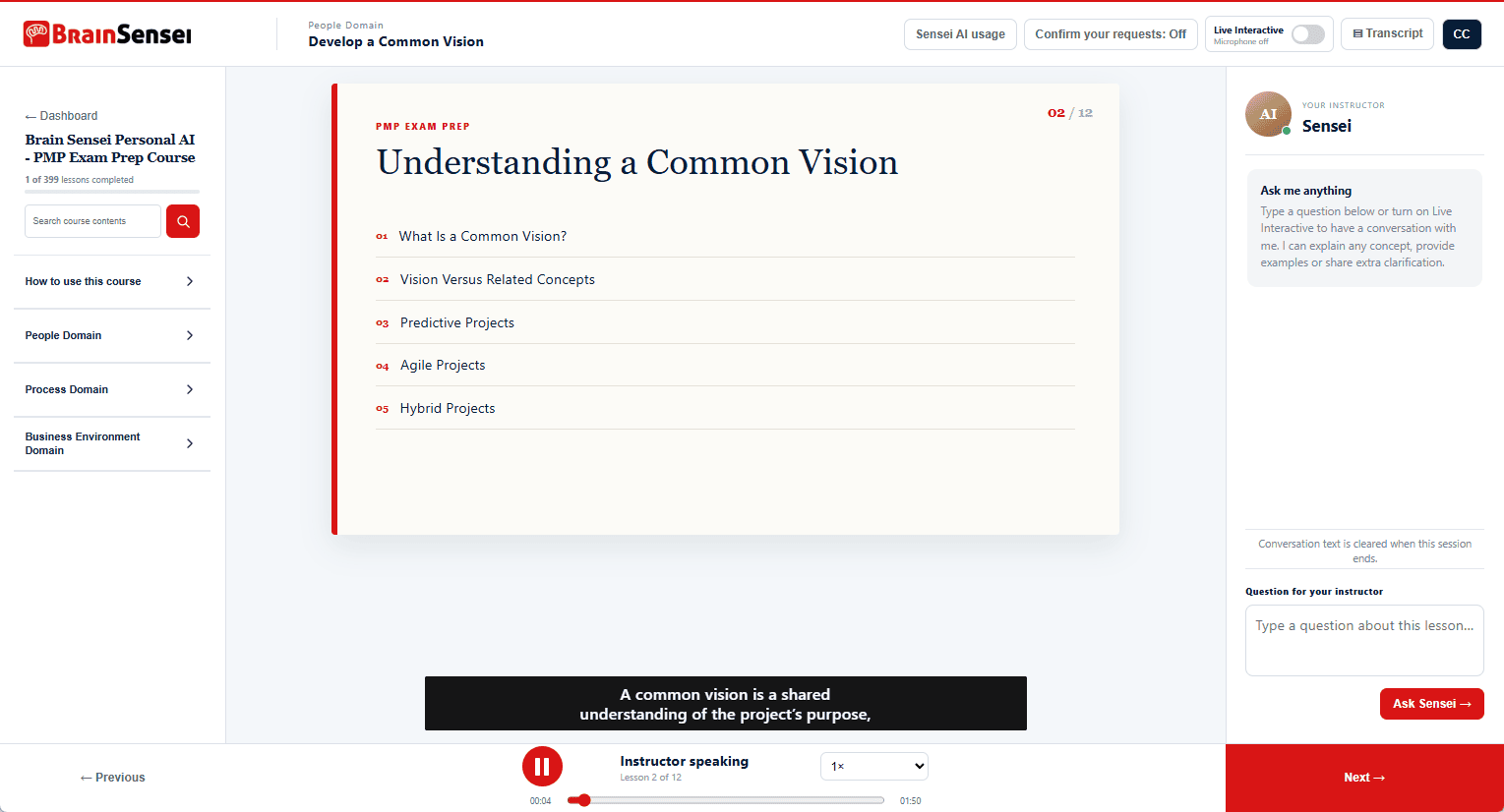
When you’re ready to practise on your own, the customizable PMP exam simulator lets you choose which exam domains to focus on and review the reasoning behind answers. For more ways to plan your sessions, see our guide to using AI for PMP exam prep.
Start a free 7-day trial to try a lesson, ask your AI Sensei a question, and take a practice quiz.